Religious Freedom in a Changing World: Faith, Pluralism, and Civic Life
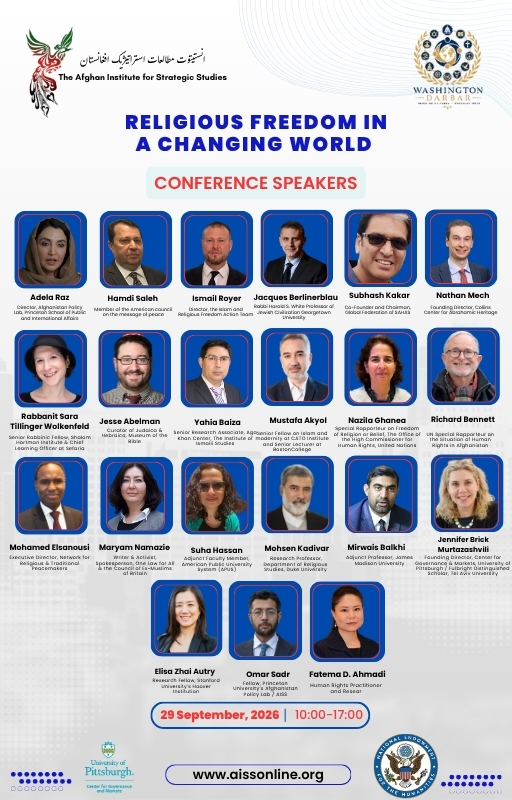
On September 29, 2026, the Afghan Institute for Strategic Studies (AISS) convened the Third Annual Washington Darbar Conference, “Religious Freedom in a Changing World: Faith, Pluralism, and Civic Life,” at the Museum of the Bible in Washington, D.C. Bringing together scholars, religious thinkers, human rights advocates, researchers, and public intellectuals, the conference examined religious freedom not only as a legal right, but as a question of political authority, pluralism, technology, conscience, and the future of civic life.
The conference opened with welcoming remarks by Dr. Jesse Abelman, Curator of Judaica and Hebraica at the Museum of the Bible, followed by introductory remarks from Dr. Davood Moradian, Director of the Afghan Institute for Strategic Studies. The opening situated the conference within AISS’s broader Washington Darbar initiative, which has sought to connect debates concerning the region with wider intellectual, religious, and political questions.
The first panel, titled “The Evolving Role of Religion in Contemporary Societies,” was moderated by Dr. Omar Sadr, Fellow at Princeton University’s Afghanistan Policy Lab and AISS. The panel brought together Ismail Royer of the Religious Freedom Institute; Professor Jacques Berlinerblau of Georgetown University; Subhash Kakar, Co-Founder and Chairman of the Global Federation of Societies of Afghan-Hindus and Sikhs; and Ambassador Hamdi Saleh, a member of the American Council on the Message of Peace. Their session approached religion as a continuing public and political force rather than a matter confined to private belief. The discussion was framed around religious awakening, public religion, pluralism, identity politics, and democratic governance, while Berlinerblau’s contribution addressed political secularism as a possible response to religious conflict.
The second panel, “Metaphysics Meets Artificial Intelligence,” was moderated by Nathan Mech, Founding Director of the Collins Center for Abrahamic Heritage at the Acton Institute. The speakers were Rabbanit Sara Tillinger Wolkenfeld, Senior Rabbinic Fellow at the Shalom Hartman Institute and Chief Learning Officer at Sefaria; Dr. Elisa Zhai Autry, Research Fellow at Stanford University’s Hoover Institution; and Dr. Yahia Baiza, Senior Research Associate at the Aga Khan Center at the Institute of Ismaili Studies, who participated virtually. The session moved the conference into a rapidly changing domain, asking how artificial intelligence, digital platforms, and algorithms are reshaping religious knowledge, discourse, authority, and spiritual life. Questions of AI ethics and algorithmic amplification placed religious freedom within a technological environment that increasingly determines how ideas are encountered and transmitted.
A special conversation, “Religious Freedom & the Future of Global Order,” followed the lunch break. Professor Jennifer Brick Murtazashvili, Professor and Founding Director of the Center for Governance and Markets at the University of Pittsburgh, moderated the discussion with Richard Bennett, United Nations Special Rapporteur on the Situation of Human Rights in Afghanistan. The conversation placed the rights of individuals and communities within the wider international order, connecting religious freedom to human rights, governance, international institutions, and the challenges confronting the protection of fundamental freedoms in Afghanistan and beyond.
The third panel, “Religious Despotism & Political Pluralism,” was moderated by human rights researcher and advocate Fatema D. Ahmadi. Professor Nazila Ghanea, United Nations Special Rapporteur on Freedom of Religion or Belief, joined virtually, alongside Dr. Omar Sadr, Dr. Mohamed Elsanousi, Executive Director of the Network for Religious and Traditional Peacemakers, and writer and activist Maryam Namazie. The panel turned directly to the relationship between religion and coercive political power. State control of religion, authoritarian governance, minority rights, apostasy, and freedom from religion framed a discussion in which religious liberty was considered not only as the right to practice a faith, but also as the right to question, change, or reject religious belief without coercion.
The fourth and final panel, “The Muslim Enlightenment: Towards Freedom, Equality & Democratic Awakening,” was moderated by Dr. Suha Hassan, Adjunct Faculty Member at the American Public University System. The panel featured Professor Mohsen Kadivar of Duke University, Dr. Mirwais Balkhi of James Madison University, and Mustafa Akyol of the Cato Institute. The session returned the discussion to the intellectual traditions and internal debates of Muslim societies, focusing on reformist thought, education, intellectual renewal, religious freedom, and contemporary Islamic discourse. The panel placed the possibility of political and social change alongside the need for freedom of thought, reinterpretation, and intellectual debate.
Across its four panels and special conversation, the Third Annual Washington Darbar treated religious freedom as a problem that cannot be separated from political power, technology, education, citizenship, minority rights, and freedom of conscience. Afghanistan remained an important point of reference, but the discussions deliberately placed its experience within wider global debates. The conference underscored that pluralism requires more than the coexistence of different beliefs: it depends on institutions, equal citizenship, the freedom to believe or not believe, and a civic order capable of protecting difference without turning religion into an instrument of political control.