
Rumi Night in Washington
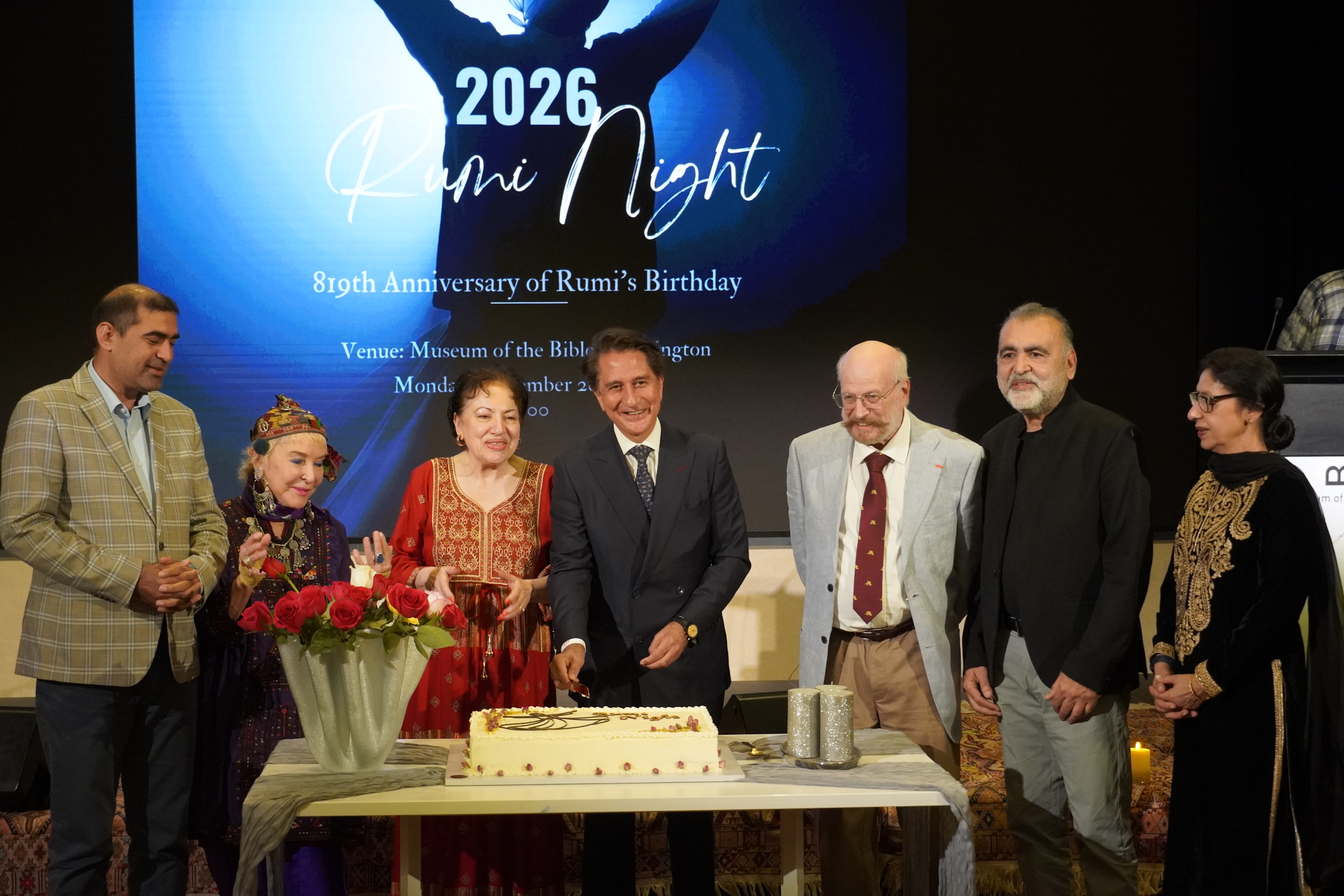
On September 28, 2026, the Afghan Institute for Strategic Studies (AISS) hosted Rumi Night in Washington at Museum of the Bible, marking the 819th anniversary of the birth of Mawlana Jalaluddin Muhammad Balkhi (Rumi). Held as the cultural component of the Third Annual Washington Darbar, the evening brought together scholars, writers, artists, musicians, and members of diverse religious and cultural communities. Through music, literature, historical memory, and conversation, the program placed Rumi’s enduring language of love and human connection alongside contemporary questions of freedom, tolerance, and coexistence. The gathering also preceded AISS’s conference on religious freedom, held the following day in Washington.
The evening opened with welcoming remarks by Ambassador Said Tayeb Jawad, former Ambassador of Afghanistan to the United States, the United Kingdom, and Russia, and a member of AISS. The first artistic segment was presented by the LA Daf Ensemble, whose performance brought the sound of the daf and the tradition of mystical music into the hall. The performance set the evening's cultural tone, recalling the long relationship between Persian poetry, spiritual practice, and music, in which Rumi’s words have continued to travel across languages, communities, and generations.
The literary segment centered on the launch of the Persian translation of Mustafa Akyol’s Reopening Muslim Minds: A Return to Reason, Freedom, and Tolerance. Akyol, Senior Fellow at the Cato Institute’s Center for Global Liberty and Prosperity, joined Dr. Wahid Gulrani, Adjunct Professor at Georgetown University, for a conversation accompanying the launch. The book’s central questions - reason, freedom, tolerance, and the place of intellectual renewal in Muslim societies - placed the evening’s celebration of Rumi in dialogue with debates that remain central to contemporary Muslim thought.
The program then turned to another part of Afghanistan’s religious history with the screening of “Jewish Cemetery in Herat.” The short presentation recalled the Jewish presence in Herat and added a dimension of historical memory to an evening otherwise centered on literature and music. In the context of Washington Darbar, the screening also served as a reminder that Afghanistan’s cultural history has never belonged to a single religious or communal tradition.
Professor Michael Barry, of Princeton University and the American University of Afghanistan, delivered the keynote address. As a historian of the Greater Middle East, Islamic civilization, Persian art, and literature, Barry brought the cultural and historical world from which Rumi emerged into the center of the evening. His address formed the intellectual core of a program that sought not simply to celebrate a famous poet, but to recall the wider civilization, artistic traditions, and spiritual imagination associated with Balkh and the Persianate world.
The gathering then marked the 819th anniversary of Rumi’s birth with a cake-cutting ceremony. The symbolic celebration was followed by a musical presentation dedicated to Afghan Hindu and Sikh cultural heritage, performed by Mukesh Pran and Masood Omari. Their participation broadened the evening from a commemoration of one literary figure into a recognition of diverse cultural inheritance and of communities whose presence has been integral to the country’s history.
The evening concluded with dinner and informal conversation among participants. Across its different parts, Rumi Night brought together Muslim mystical heritage, Afghan Jewish memory, Hindu and Sikh cultural traditions, contemporary debates on Muslim thought, and the arts. The program did not present these histories in isolation. Instead, it placed them in a shared cultural space, with Rumi serving as a bridge between memory and the present, between dispersed communities, and between distinct traditions connected by a longer history of coexistence.