
The Taliban's Strategies of Intimidation and Their End Goals for Political Change
By Sowieba Abadi
The Taliban emerged in 1994 as a movement of religious students whose initial mobilization was framed around ending Afghanistan's civil war and restoring order. However, after gaining power, the movement's behavior diverged from its earlier rhetoric, revealing a shift from a conflict-ending narrative towards the consolidation of political authority. After seizing power, the Taliban combined their interpretation of Islam with tribal norms such as Pashtunwali, producing a governance model characterized by social regulation and behavioral control. Following the September 11 attacks, the Taliban lost formal state power but re-emerged as an insurgent movement, adopting strategies suited to waging a prolonged conflict over the subsequent two decades. Throughout this period, the group relied on coercive violence and civilian intimidation as strategic instruments for advancing political objectives. This essay analyses how the Taliban's systematic use of intimidation, particularly suicide attacks and targeted assassinations, functioned as a strategic tool for securing and consolidating political control in Afghanistan.
Intimidation constitutes one of the core strategic logics of terrorist violence groups like the Taliban. Scholars conceptualize intimidation as a coercive strategy through which armed groups seek to demonstrate their capacity to punish disobedience while simultaneously signaling the state's inability to provide protection. This strategy is most commonly employed when the primary objective is either to overthrow an existing regime or to establish social control over a population. Rather than relying on indiscriminate violence alone, intimidation often involves selective targeting of visible state representatives, collaborators, and civilians in contested areas, thereby reshaping behavioral incentives and compelling compliance through fear.
After 9/11, the Taliban increasingly prioritized strategies aimed at reasserting authority, combining political maneuvering with sustained military pressure. Existing scholarship suggests that conditions of state fragility and complex geography generate permissive environments in which intimidation strategies become effective instruments of regime change. In the Afghan context, these structural conditions, namely limited state capacity and rugged terrain, enabled the Taliban to institutionalize intimidation as a strategic instrument of political control. The Taliban's use of intimidation reflects the strategic logic identified by scholars of terrorism, whereby violence operates as a form of coercive demonstration designed to demonstrate the movement's capacity to punish defection and expose state weakness. Their tactical repertoire encompassed suicide operations, targeted assassinations, conventional military operations, night letters, propaganda, and strategic negotiations, which collectively functioned as mechanisms of civilian coercion and instruments of power consolidation. Suicide operations functioned as a form of coercive signaling aimed at shaping civilian behavior and deterring resistance. Because suicide operations require irreversible commitment, they serve as highly credible signals of organisational resolve, intensifying fear, raising the perceived costs of resistance, and reinforcing the Taliban's capacity to exercise coercive political influence. These operations and bombings constituted a central component of the Taliban's strategy of intimidation, functioning as mechanisms of civilian coercion and strategic signaling within a protracted insurgency. By targeting highly visible civilian locations such as mosques, schools, and markets, these attacks maximized psychological impact and undermined confidence in the state's capacity to provide protection.
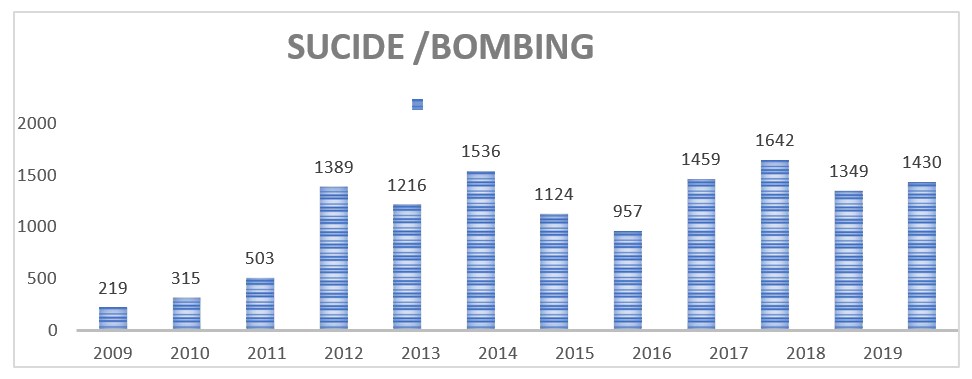
Data from the Global Terrorism Database indicates a marked escalation in suicide operations, with attacks and bombings rising from 219 in 2009 to 1,430 in 2020, reflecting their institutionalization as a core tactic within Taliban strategy to maintain coercive pressure. Even after regaining authority in 2021, the Taliban continue to publicly display their suicide units, treating them as a central arm of their power that reflects the persistence of the organizational level. The public recognition of suicide attackers reinforced internal incentives and contributed to the institutionalization of suicide attacks as a legitimate form of operational participation. Leadership endorsement and personal association with such operations strengthened the symbolic legitimacy of the tactic, signaling sustained strategic commitment and reinforcing its role in power consolidation. The prominence of suicide attacks within the Taliban's operational doctrine is not limited to rank-and-file militants; it has extended symbolically into the leadership sphere itself. This dynamic illustrates how martyrdom is not merely framed as a tactic, but as a core ideological instrument that reinforces authority, legitimacy, and organizational cohesion.
Reports indicate that the son of Taliban leader Hibatullah Akhundzada, Abdul Rahman Khalid, carried out a suicide attack in 2017 targeting Afghan security forces in Helmand. The Taliban have publicly emphasized suicide strategies, portraying them as evidence that sacrifice extended even to leaders' families in pursuit of their strategic objective of collapsing the Islamic Republic of Afghanistan and confronting the presence of the United States and NATO during war. Individuals associated with suicide operations subsequently gained organizational leverage and status following the movement's return to power. For instance, Interior Minister Sirajuddin Haqqani stated that more than 1,050 members of the Haqqani Network had carried out suicide attacks over fifteen years, urging recognition of their sacrifices.
Meanwhile, assassinations have become a central strategy for the Taliban over the past two decades, significantly aiding their return to power. Quantitative evidence demonstrates that the Taliban systematically expanded intimidation-based violence over time. According to the Global Terrorism Database, operations involving suicide bombings and explosive attacks rose sharply from 219 incidents in 2009 to 1,430 by 2020, reflecting a deliberate strategy of coercive signaling targeting civilians, local elites, and state institutions. Simultaneously, the Taliban scaled up improvised explosive device (IEDs) production, planting approximately 20,000 devices in key provinces such as Kandahar by 2014, generating persistent insecurity that restricted mobility and undermined governance. Together, these tactics reshaped civilian expectations, increased the perceived costs of resistance, and created the political conditions that enabled the Taliban's eventual consolidation of power.
Furthermore, targeted assassinations constituted a central mechanism of Taliban intimidation over the past two decades because they enabled selective coercion against political and security elites while signaling state incapacity and weakening anti-Taliban resistance. This pattern reflects the logic of selective violence advanced in scholarly literature, which argues that insurgent groups employ targeted killings to consolidate territorial control by deterring collaboration and reshaping local power structures. Therefore, the Taliban's assassination functions not as indiscriminate brutality but as a calculated mechanism of political regulation.
The targeting of figures including former President Burhanuddin Rabbani, senior security commanders such as Dawood Dawood, elite members of the Northern Alliance, journalists, and civil society actors reflects a calculated strategy of elite decapitation. This approach seeks to systematically eliminate influential anti-Taliban figures, weaken institutional leadership, disrupt governance networks, and generate a deterrent effect that discourages collaboration with the state. By removing visible representatives of state authority and anti-Taliban actors, assassinations increased the perceived risks of cooperation with government institutions and gradually reduced organized resistance. Evidence from the United Nations Assistance Mission in Afghanistan indicates that anti-government elements were responsible for 62% of civilian casualties in 2020, with 45% attributed to the Taliban. This distribution highlights the Taliban's strategic use of violence to establish the credibility of punishment, a central mechanism of coercive control that signals both the capacity and willingness to impose costs on civilians perceived to be aligned with the state. Similarly, data from the Global Terrorism Database records 1,311 assassination incidents attributed to the Taliban between 2009 and 2020, demonstrating that assassination operated not as episodic violence but as a sustained strategy of selective intimidation.
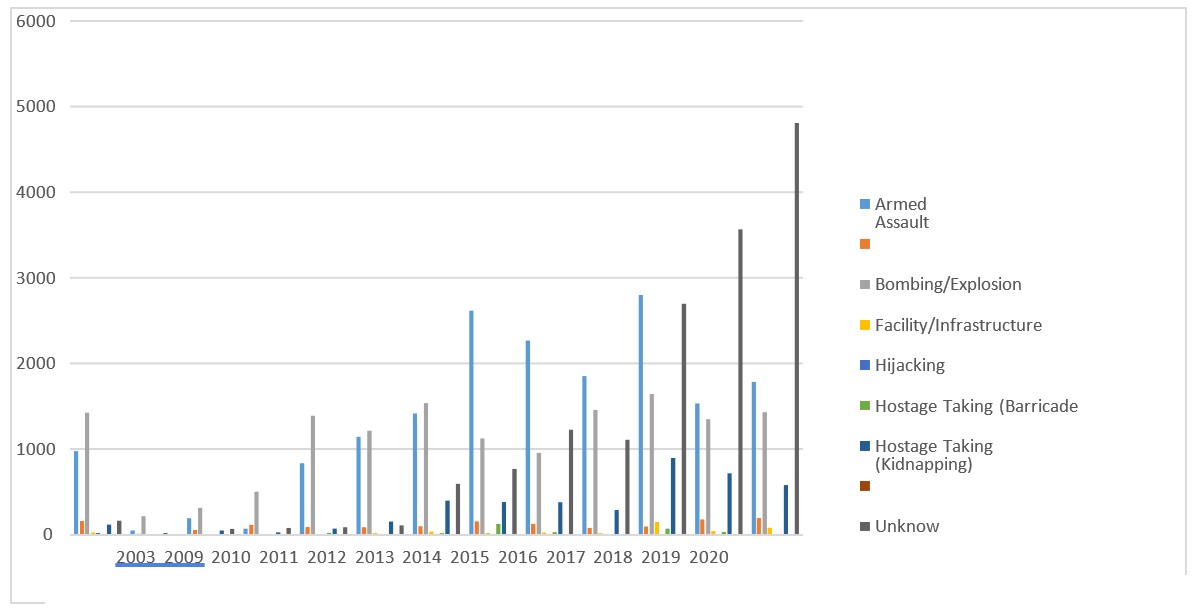
Taken together, these datasets provide a robust empirical basis for interpreting targeted killings as a systematic instrument of governance disruption: civilian harm reinforces coercive signaling at the population level, while the persistence of assassinations operationalizes elite decapitation, collectively institutionalizing fear, reshaping collaboration incentives, and eroding organized resistance. Thus, assassination campaigns generated targeted fear that reshaped elite risk calculations, incentivizing neutrality, silence, or strategic accommodation. These patterns indicate that intimidation operated not merely as a tactical instrument of battlefield pressure but as a mechanism of political transformation that restructured authority, altered patterns of cooperation, and enabled insurgent governance.
In conclusion, the Taliban's systematic use of intimidation was not a peripheral tactic but as a central mechanism of political transformation. Ultimately, the Taliban's intimidation strategies were oriented toward three interrelated end goals: the erosion of state legitimacy, the reconfiguration of local authority structures, and the creation of conditions conducive to regime replacement, goals which were progressively realised over the course of the conflict and culminated in the movement's return to power in August 2021. By combining suicide attacks and targeted assassinations, the movement generated fear, reshaped elite calculations, and signalled state weakness. This integrated strategy of coercive governance created the political and psychological conditions necessary for regime collapse and subsequent power consolidation, demonstrating that intimidation can function as a decisive instrument in achieving insurgent objectives.
Sowieba Abadi is an MA International Relations Student at Brunel University London.
Academicians and Officials interested in publishing their academic pieces on this page, please approach us through contact@aissonline.org.
The article does not reflect the official opinion of the AISS.