
“Hum leke rahenge azadi”: Indian Roaches Set an Inspiration for Afghan Gen Z
By Neelapu Shanti
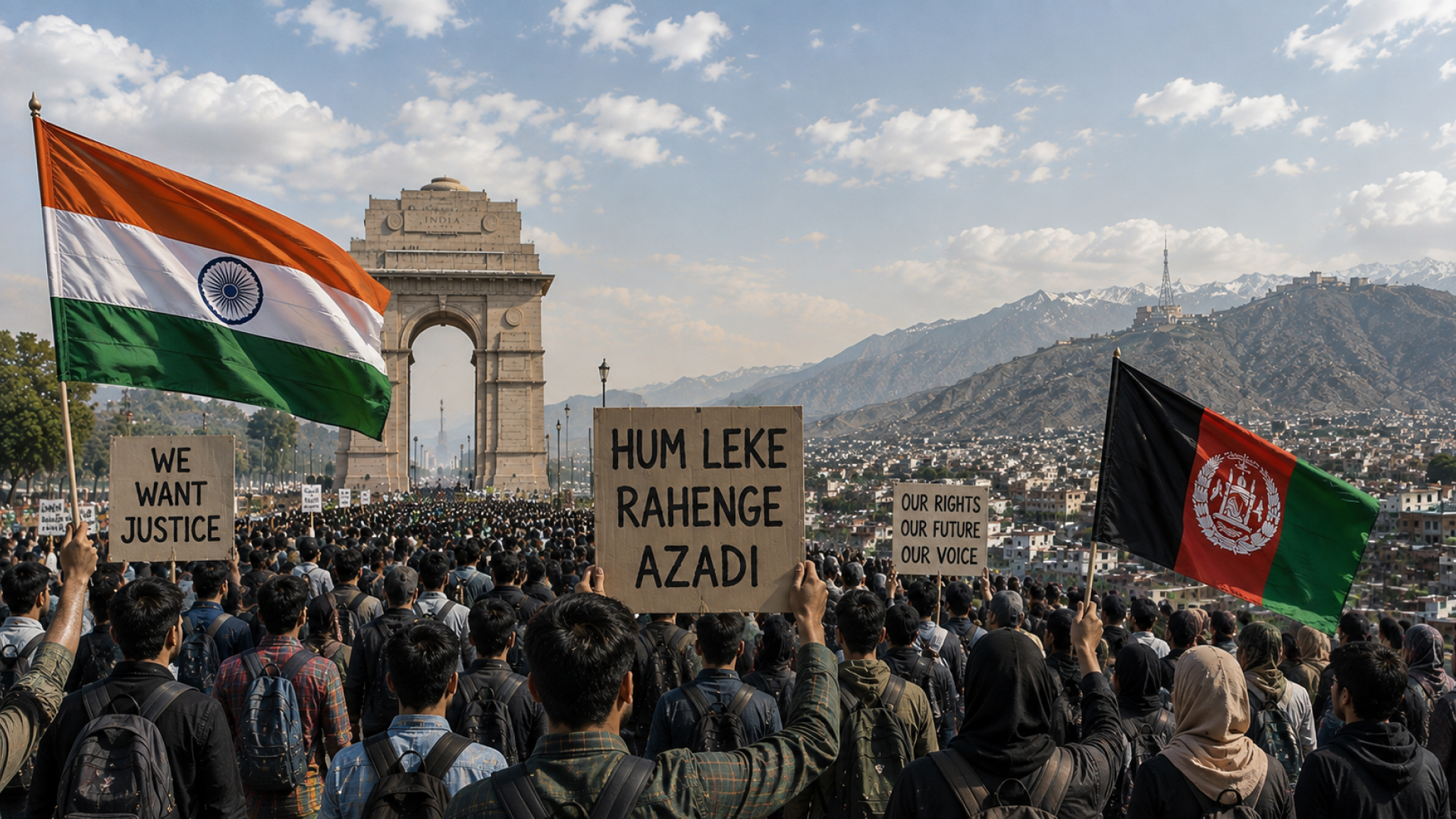
The Indian Gen Z protest sloganeering and chanting - ‘Hum leke rahenge azadi’ made huge headline in India and International media last month. The same voice meets the energy of Afghan Youth living under the Taliban’s regressive regime whose ill-will do no justice to the aspirations of people to attain their fundamental freedoms.
The Cockroach Janta Party (CJP) - “Voice of the Burnt-out Youth’ with a vision “Build a party for a generation raised on promises, notifications, and low battery warnings. A generation that is overqualified, frustrated, angry at what's broken, and financially confused. That's it. That's the mission. The rest is satire”, calling for a revitalized democratic setup with people at its centre. And demanding more accountability.
The rallying points and broader frustration of the youth not only rattled the ruling Bhartiya Janta Party (BJP) but it ended with the resignation of Education Minister Dharmendra Pradhan-an inescapable truth.
It is hard to perceive that it began when the Chief Justice of India disparaging remark to a section of youth as ‘cockroaches’ in a hearing on May 15, 2026. The protests evolved with a long simmering frustration and lack of accountability of government of India over examination paper leaks, unemployment, failing institutions and political indifference.
“The CJI’s remarks on May 15 during a hearing likening unemployed youth in law to cockroaches had led to an uproar culminating in the creation of the Cockroach Janata Party (CJP), with many interpreting it as comments targeting the entire youth community and not just the legal profession”, reported the Indian Express dated 25 July 2026.
Former Police Chief, Prakash Singh wrote on X, “Out of the 31 Chief Ministers analysed from State Assemblies and Union Territories 14 (45%) Chief Ministers have declared criminal cases against themselves. The average of assets per Chief Minister is Rs.118.07 Crores. - ADR.
In a democratic landscape, the conscience of people and its future generation remain the benchmark. The democratic movements derive their legitimacy from the courage. That is how national ownership of democratic movements takes root.
The seven democratic principles- sovereignty, political equality, the rule of law, majority rule with minority rights, individual rights and freedoms, free and fair elections, and the separation of powers-plays rightful role in the pursuit of peace and security. This is how accountability deepens responding to national priorities.
Lt. Gen. Prakash Katoch in his latest article, titled, ‘Hedgehogs and Cockroaches’, published in The Strategic Perspective, stated that “The fact is redlines of misgovernance, outdated education/examination systems, successive paper-leaks, intransigence to student suicides and uncertain future of youth, unemployment, job opportunities for general category gone worse with reservations, and endemic corruption, were crossed, which led to mass protests. No amount of sloganeering and hubris over Hindutva can deflect from this”.
Therefore, the political compass needs to deliver on a practical framework to align national priorities that are visible, credible and responsive to meet people-oriented goals.
Indian Youth and Afghan Youth- Energy Dynamics
On X, Ambassador Tahir Qadiry wrote on 28 July 2026: “India’s “Cockroach Party” @CJP_2029 has shown how a determined GenZ can rattle even a powerful ruling party. For Afghanistan’s Gen Z—living under Taliban restrictions, especially on girls’ rights—the question is what role they can play”?
As the CJP movement gained ground who chose courage over silence, we are reminded of Afghan youth who stands out as a beacon of hope living under the Taliban’s regime.
The values embodied by Bharat Ratna awardee Khan Abdul Ghaffar Khan- also known as Frontier Gandhi and Badshah Khan- and Mahatma Gandhi remain a symbol of hope in a world marked by emerging conflicts. Their courage, determination and statesmanship continue to inspire generations. Based on this shared legacy, the youth of India can offer profound support to Afghan youth in building resilience and reinforcing pathways- an essence of diplomacy, dialogue and international law.
The question is, how the regional countries can support Afghan youth in shaping a strategic vision and foresight for a legitimate government and assessing international law to better protect the interests of future generations of Afghans- and ensuring that those who are left behind are not forgotten.
UN’s Vision for Youth Building
In 1965, in resolution 2037 (XX), the General Assembly endorsed the Declaration on the Promotion among Youth of the Ideals of Peace, Mutual Respect and Understanding between Peoples.
In December 2009, the United Nations General Assembly adopted resolution 64/134 proclaiming the year commencing 12 August 2010 as the International Year of Youth, calling upon governments, civil society, individuals and communities worldwide to support activities at local and international levels to mark the event.
Security Council Resolution 2250 (9 December 2015) on Youth, Peace and Security represents an unprecedented acknowledgement of the urgent need to engage young peacebuilders in promoting peace and countering extremism, and clearly positions youth as important partners in the global efforts.
The universal nature of the 2030 Agenda for Sustainable Development, and its pledge to leave no one behind should have been delivered concretely at a time when the generations of Afghan youth both male and female whose human potential is being systematically underutilized- lost human-capital crisis under the Taliban-led Afghanistan.
In a post on X marking World Population Day, UNFPA said 63% of Afghanistan’s population is made up of young people below the age of 24 and reaffirmed its commitment to supporting them. The demographic statistics reflect Afghanistan as the youngest population in the world.
The future of any country and the development of the nation depend on youth as they carry tremendous energy and ambition to lead in a progressive path for peace, prosperity and growth. Therefore, it is important to motivate and uplift their talent to achieve their visionary goals. The engagement of youth in nation building is a pivotal factor and they play a very important role in nation-building.
Taliban’s restrictions on girls’ education are no less destructive than that of warfare itself. Indeed, the impact is far worse in causing social and economic crises and inward and outward displacement since 2025 has increased the scale of crisis under the Taliban’s regressive dominance.
The Afghan youth vision an Afghanistan where people are free, and can go about their normal life, governed by a concerned and an involved government taking care of the day-to-day needs of its citizens while preparing the country to be a global player, heading towards a purposeful and a prosperous future.
Younger generation is the interface of new Afghanistan. The advancement of any culture or society or nation primarily depends on the policy apparatus and that comes along with the change in mindset in order to keep pace with the rapidly changing world.
The generation shift makes the role of the youth more prominent in terms of defining responsibilities they undertake that forge concrete outcome in identifying greatest levers in addressing infrastructural and societal challenges in the country. – a crucial Instrument to build better Afghanistan.
Real progress is when the equality index shows marked improvement of youth development including women.
Is India's Support for Afghan Youth Truly Credible?
From strategic autonomy to silent alignment, India’s relationship deepened over the last 3 years with the Taliban when the political objectives are becoming increasingly obscured for mutual gains sidelining the genuine concerns of the Afghan people attached to inclusive government.
In 2013, the Secretariat of the South Asian Association for Regional Cooperation (SAARC) drafted the SAARC Youth Charter- a living document- which focuses on five key areas: an enabling environment, gender equality, education and skills development, employment and health. In May 2014, the Secretariat organized a regional consultative meeting to finalize the SAARC Youth Charter and Action Plan.
However, and despite strong evidence of commitment of SAARC countries including India, instead of finding ways in upholding the principles of the Charter, and acting in defence of common humanity to support Afghan youth have conveniently endorsed the Taliban rule and intensified their engagements.
It is vitally important that India’s commitment to Afghanistan’s peace- an inclusive and legitimate government- be as strong as the commitment to Taliban.
India chose to stand aside at the United Nations table when gross and systematic violations of human rights are taking place in Taliban-led Afghanistan. The tragic irony is India’s so-called humanitarian intervention overlooked the legitimate and universal principles for the people of Afghanistan. The issues of Afghan women’s rights who are out of school for the last five years. has prompted important questions about India’s real term support as it has been touting all along since it reopened its Embassy in Afghanistan in 2022.
"With 21.9 million people—nearly half the country—projected to need humanitarian assistance in 2026, Afghanistan’s crisis is being deepened by Taliban repression, gender apartheid, economic collapse, food insecurity, record malnutrition, climate shocks, aid cuts, mass forced returns from Iran and Pakistan, and the absence of an inclusive legitimate government,” said Ambassador M. Ashraf Haidari in a post on X.
The visa extension requests of the 61 Afghan Cadets who have stayed back in India following the completion of their courses in various Indian military academies has been rejected by the Foreigners Registration Office (FRRO) in 2023.
Surviving the turbulence and also the dangerous heat of jet engine and radiators located near the landing gears, a 13-year-old boy who reached New Delhi from Kabul hiding in the flight last year was sent back to Afghanistan. It has only defined inaction in the face of apathy and helplessness of a child.
It is believed New Delhi’s conscience have failed to follow suit. Humanity, after all, is indivisible.
India revoked visas of Afghan students since 2021 who visited India for pursuing studies. The Indian Council for Cultural Relations (ICCR) offers online scholarships annually for Afghan students whose lasting significance still eludes us.
India’s diplomacy for the people of Afghanistan will continue to fail until it is a proven platform for partnership to work across all level of governance, to serve as an inclusive platform for policy dialogue for legitimacy and coordination among regional stakeholders, and, importantly, not to act simply appeasing the Taliban for political gains.
Afghanistan Youth Parliament
Afghanistan’s Youth Parliament was established on 14 August 2016 through the Deputy Ministry of Youth Affairs, with financial backing from the United Nations Population Fund (UNFPA) and coordination from the upper house of the parliament (Mashrano Jirga consists of three members from each province across the country, was set up to promote leadership skills among young Afghans and to increase awareness about issues ranging from democracy and rule of law to good governance and human rights.
The erstwhile Government of Afghanistan was committed to fulfilling its responsibility to protect the rights of all youth and to addressing violations of youth’s rights. The government has initiated several important steps at the national, regional and international levels this includes the launch of a National Youth Programme, which reiterated the commitment to the development of the sons and daughters of Afghanistan and sought to establish an opportunity for Afghan youth to fulfil their aspirations.
Hum leke rahenge azadi!
“What if all cockroaches come together?” Indian and Afghan youth- reflects precisely the unity of purpose.
Young cockroaches can form a significant demography in Afghanistan too. If they get response from CJP, it would be an empowering one with a collective voice.
A chance to identify synergies of India and Afghanistan’s Gen Z in implementing internationally agreed commitments for a legitimate and inclusive government in Afghanistan which has been sidelined to meet political leverages over accountability. And an opportunity to stand in response to the changing realities of the Taliban.
In its most basic sense, the world must seek new responsibilities, and new possibilities dissecting rhetoric politics to advance peace and progress in Afghanistan. It must be understood how the people, especially the new generations of Afghans whose human rights and fundamental freedoms are secluded under the Taliban’s dominance.
Afghanistan needs more than just words of sympathy from the international community. They need a real and sustained commitment to help end their cycles of poverty which can only happen through an inclusive governance set up based on democratic practices and launch them on a safe passage to prosperity.
The inability of the international community is viewed as a tragedy for Afghans as they failed to reconcile the compelling interests of the people-legitimacy and effectiveness in defence of human rights.
Our reflection from a variety of challenges that confront Afghanistan today- ‘Hum leke rahenge azadi’ sets a perfect note of inspiration for Afghan youth and the world to understand that youth are not just leaders of tomorrow, but changemakers today.
------------
Neelapu Shanti is a New Delhi Based international affairs research analyst, writer, journalist and Indo-Afghan analyst. MA in International Relations Post-Graduate in Journalism.
-----------
Academicians and Officials interested in publishing their academic pieces on this page, please approach us through contact@aissonline.org.
The article does not reflect the official opinion of the AISS.