Taliban’s Dystopian Experiment &A Nation in Revolt
By Dr. Davood Moradian
Five years after their return to Kabul, the Taliban have built more than an Islamic Emirate. They are testing whether an authoritarian religious order can erase a plural society. Afghanistan’s women are proving that it cannot.
On 15 August 2021, Afghanistan did not merely change governments. It experienced a political rupture whose consequences extend far beyond the country’s borders. The Taliban’s triumphant entry into Kabul marked the collapse of the Afghan Republic, the humiliating end of the Western intervention and the return of a movement that many in the West had once assumed belonged to Afghanistan’s violent past.
For Afghans, however, the meaning was more visceral. The republic’s fall was experienced as the collapse of a fragile but real social transformation: millions of girls had gone to school, women had entered universities and professions, new forms of political and cultural expression had emerged, and Afghanistan’s young generation had begun to imagine itself as something other than the permanent victim of history.
The Taliban returned with a radically different proposition. They did not intend simply to govern Afghanistan. They intended to remake it.
The symbolism was immediate. The Ministry of Women’s Affairs was abolished and replaced by the Ministry for the Propagation of Virtue and Prevention of Vice. Women began disappearing from public institutions, schools and workplaces. The new authorities reinstated the vocabulary and institutions of the old Islamic Emirate, making clear that their victory was not merely military but ideological.
And yet, almost simultaneously, another Afghanistan appeared.
Only days after the Taliban entered Herat, Afghan women took to the streets to protest. Their message was remarkably simple: the Taliban might have conquered the state, but they had not conquered Afghan society.
Five years later, the struggle over Afghanistan can be understood through three interconnected developments: the construction of what might be called the Kandahar model of Islamist government; the return of Afghanistan as a theatre of geopolitical competition; and the emergence of an increasingly sophisticated resistance, led above all by Afghan women.
The Kandahar model
In much Western commentary, the Taliban have too often been reduced to a group of rustic religious extremists who unexpectedly defeated the most powerful military alliance in history. This is comforting because it makes the Taliban appear anomalous and therefore easier to dismiss.
They are not anomalous.
The Taliban represent one of the most ambitious experiments in contemporary Islamist government. Their project is to construct a political order in which religious authority supersedes popular sovereignty and the interpretation of Sharia provides the principal source of political legitimacy.
This is why the term “Islamic Emirate” matters. It is not merely a change of terminology from “republic” to “emirate”. It describes a fundamentally different conception of political authority.
The supreme leader, Hibatullah Akhundzada, is not a president who derives legitimacy from an electorate. He is the Amir, whose authority is rooted in a particular interpretation of Islamic jurisprudence and whose decisions are increasingly insulated from institutional checks and public accountability. The concentration of power in Kandahar has turned the Taliban leadership into something resembling a clerical court governing a modern state.
The paradox is striking. The Taliban have taken control of the machinery of a twenty-first-century state while attempting to organise society according to a social and political imagination rooted in a much older world.
The most dramatic expression of this contradiction is the position of women.
Since August 2021, the Taliban have constructed a system of restrictions that has removed women and girls from almost every sphere of public life. Secondary and higher education have been closed to girls and women; employment has been severely restricted; freedom of movement curtailed; and women have been increasingly excluded from public spaces.
This is not simply discrimination. It is the attempted institutionalisation of female invisibility.
The UN and numerous international legal experts have increasingly described the system as gender persecution or gender apartheid. Whatever terminology one chooses, the political reality is unmistakable: the Taliban have made the subordination of women one of the organising principles of their state.
A traditional Pashtun’s saying – Taliban’s main ethnic basis- captures the mentality with brutal economy: a woman’s place is either the home or the grave.
The Taliban have attempted to turn this patriarchal maxim into public policy.
Yet there is another important dimension to their project that receives less attention: cultural homogenisation.
Afghanistan is not simply a Muslim country. It is also one of the historic centres of Persianate civilisation. For centuries, Persian, known by its other name, Dari was a language of literature, administration, scholarship and political culture across large parts of the country. Kabul, Herat, Balkh and other cities were deeply connected to the wider Persianate world.
The Taliban’s political culture, overwhelmingly shaped by Pashtun, Sunni Hanafi and Deobandi traditions, has profoundly altered this balance. Pashto has acquired unprecedented political prominence, while Persian/Dari-speaking communities increasingly perceive the new order as culturally exclusionary.
But it would be misleading to portray the Taliban as synonymous with the Pashtuns.
They are not.
Many Pashtuns reject the Taliban’s political theology and authoritarianism. Indeed, the Taliban’s own internal history is marked by tribal rivalries and tensions. The movement’s attempt to present itself as the authentic representative of Pashtun Afghanistan has therefore generated its own contradictions.
Nor is the Taliban’s authoritarianism directed only at ethnic or linguistic communities. Religious pluralism has also been squeezed. Afghanistan’s Shia communities, particularly the Hazara population, have faced discrimination, restrictions and insecurity.
The Taliban’s relationship with other Islamist movements reveals another paradox. Islamism is not one coherent ideological bloc. The Taliban have fought the Islamic State Khorasan Province precisely because the latter considers them insufficiently radical and religiously illegitimate. Yet the Taliban have maintained a much more accommodating relationship with al-Qaida.
The distinctions matter because they demonstrate that Afghanistan is not witnessing a simple confrontation between “Islamists” and “the West”. It is a much more complex struggle over competing interpretations of Islam, political legitimacy and the meaning of the state.
At the heart of the Taliban’s system is the concept of obedience.
The almost complete absence of public images of Hibatullah Akhundzada is particularly revealing. In an age when politicians everywhere compete for visibility, the Taliban leader has cultivated invisibility. His absence from public life helps transform him from a politician into something closer to a sacred authority.
He appoints senior officials across the state and presents himself as the ultimate guardian of Sharia.
And this is where the Taliban’s political philosophy becomes fundamentally incompatible with the modern constitutional order.
Sharia, in their conception, is not simply a legal framework. It is the ideological foundation of the state. Political pluralism, separation of powers, individual autonomy, gender equality and democratic representation are not the organising principles.
Obedience is.
Jihad is.
Allegiance is.
Salvation is.
The social consequences have been catastrophic. Afghanistan remains among the world’s poorest countries, with millions dependent on humanitarian assistance and a generation of girls effectively excluded from formal education.
A country once described as a fragile democracy has become, in the words of European Parliamentarian Hannah Neumann, a “hell”.
The return of the Great Game
Afghanistan’s tragedy is inseparable from its geography.
The country has spent much of its modern history caught between larger powers. The nineteenth-century rivalry between Britain and Russia helped produce the political geography of modern Afghanistan. The Cold War transformed it into a battlefield between the Soviet Union and the Western bloc. After 9/11, it became the centre of the global war on terrorism.
The Taliban victory has produced a new version of this Great Game.
But this time the contest is not primarily about supporting rival Afghan factions. It is about influencing the Taliban themselves.
The irony is profound.
For twenty years, Western governments fought the Taliban in the name of building a different Afghanistan. After the Taliban’s victory, many of the same governments—and their regional competitors—began searching for ways to deal with the movement they had failed to defeat.
CIA Director William Burns travelled secretly to Kabul in August 2021 to meet Taliban leader Abdul Ghani Baradar. Pakistan’s intelligence chief, General Faiz Hameed, soon appeared in Kabul. Their visits illustrated the scramble to understand and influence the new rulers.
The race quickly widened.
Qatar offered diplomatic access. China pursued security and economic interests. Russia moved towards normalisation. Iran expanded trade and security cooperation. India reopened channels. Turkey and the United Arab Emirates cultivated their own relationships. The European Union developed a pragmatic engagement focused heavily on migration, humanitarian assistance and regional stability.
Each actor had a different objective.
The Taliban understood this perfectly.
They have become remarkably adept at turning international rivalry into political capital. They engage one power against another, accept humanitarian and economic assistance without accepting the political conditions attached to it, and exploit the fact that no major regional actor wants Afghanistan to collapse completely.
Iran’s position is particularly instructive.
The Taliban and the Islamic Republic of Iran are ideological rivals: one is Sunni and Deobandi, the other Shiite and revolutionary. Yet geopolitics has proved stronger than theology. Tehran and the Taliban cooperate over borders, trade, migration, water and regional security. Iran has consequently emerged as one of the Taliban’s most important regional interlocutors.
China and Russia have adopted a similar logic from different directions. Neither wants to see Afghanistan become a base for transnational jihadist movements or a source of regional instability or again a Western ally.Both therefore prefer engagement with the Taliban to political isolation or Western’s return.
Pakistan’s experience has been more bitter.
Islamabad once viewed the Taliban as a strategic asset. Today, it faces a militant threat from the Pakistani Taliban, while relations with Kabul have deteriorated dramatically. The old assumption that a Taliban government would automatically serve Pakistan’s interests has proved disastrously simplistic.
Washington faces its own paradox. The United States has sought to prevent humanitarian collapse and preserve counterterrorism channels by channeling billions of dollars to the Taliban; while refusing to recognise the Taliban formally. But engagement has not produced the transformation some hoped for.
The Taliban have not become moderate because foreign governments have engaged with them.
They have simply become better at managing foreign governments.
That may be the central lesson of the new Great Game: external powers are competing to influence the Taliban, while the Taliban are competing to influence the external powers.
The Afghan population remains the least powerful player in the game.
Herat and the politics of resistance
But power is never merely coercive. Political systems survive not only because they can punish their opponents, but because their opponents eventually stop believing that resistance is possible.
This is precisely where the Taliban may have made their greatest miscalculation.
They attempted to close almost every avenue through which women could appear in public life. Afghan women responded by creating new ones.
They established underground schools, informal universities, vocational networks and online platforms. They organised demonstrations. They documented abuses. They campaigned internationally. Some simply refused to disappear.
In Afghanistan, everyday life has become political.
A classroom becomes an act of defiance.
A woman walking without the Taliban’s permission becomes an act of defiance.
A colourful scarf can become an act of defiance.
And nowhere is this more symbolically powerful than Herat.
Herat is one of Afghanistan’s great historical cities. Its Persianate cultural heritage connects it to a civilisation that stretches across Afghanistan, Iran and Central Asia. It was a centre of poetry, scholarship, art and architecture and the home of some of the most remarkable women in Afghan history.
Queen Gawhar Shad is perhaps the most powerful historical symbol. In the fifteenth century, she sponsored mosques, schools and cultural institutions and helped make Herat one of the great intellectual centres of the Timurid world.
Modern Herat once offered another symbol of possibility. Herat University became the first Afghan university where women reportedly outnumbered men among students in 2015.
The Taliban reversed that history.
The university gates that had once opened to growing numbers of women eventually closed to them altogether.
Yet Herat did not become silent.
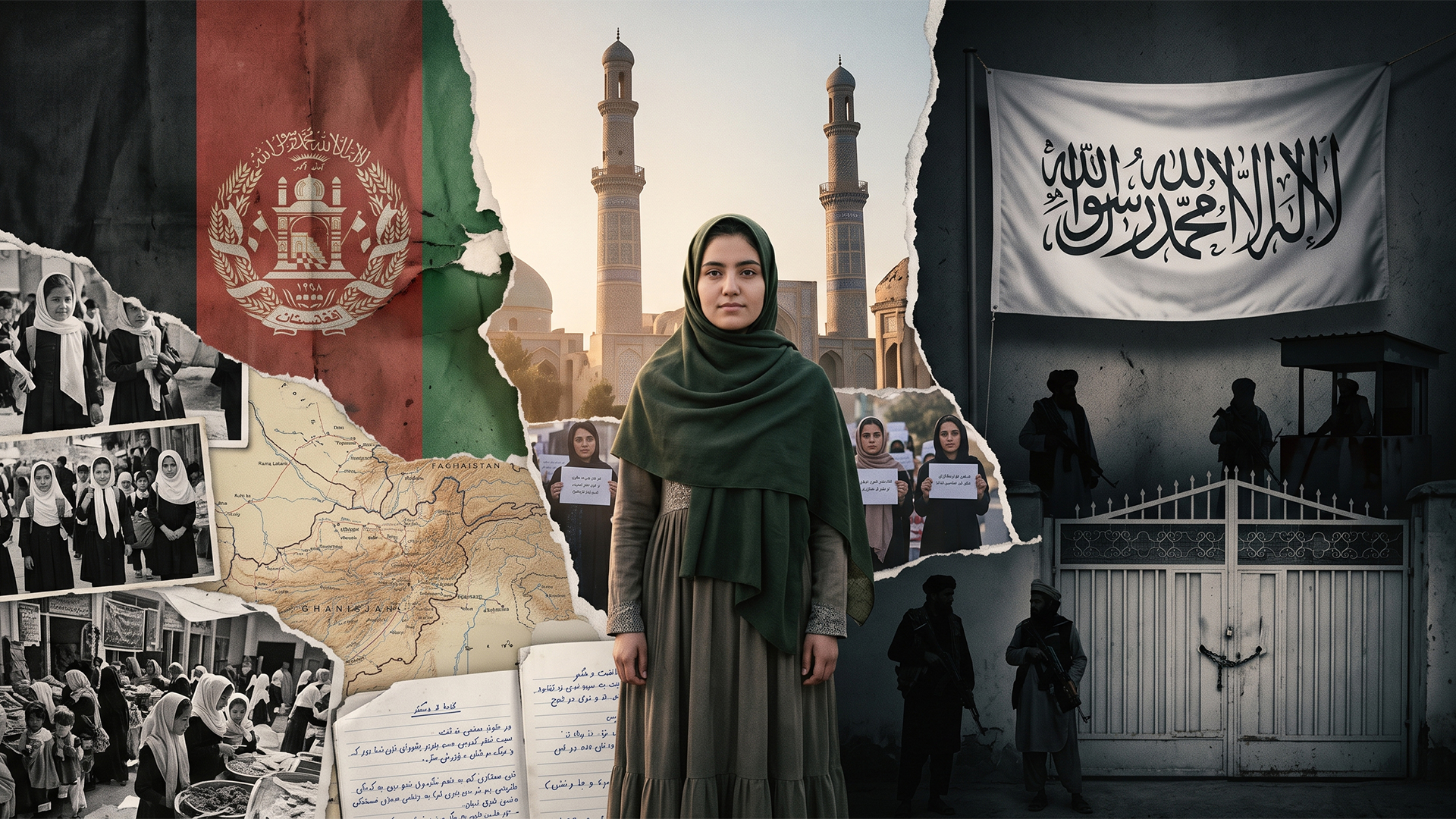
In June 2026, women again took to the streets across the city in protest against Taliban restrictions. The demonstrations lasted several days and were met with force, arrests and deaths. The events were a reminder that the Taliban’s attempt to make women invisible has produced precisely the opposite result: women have become the most visible political challenge to the Emirate.
The resistance is no longer confined to women.
Small armed opposition groups continue to operate in several parts of Afghanistan. In July 2026, the Afghanistan Freedom Front reported advances in Badakhshan, including the liberation of a district—an indication that the Taliban’s control, although extensive, is not synonymous with political legitimacy.
More importantly, Afghanistan’s fragmented political forces have begun to recognise the necessity of collaboration.
The Afghan diaspora has become part of this process. Women activists, lawyers, academics, journalists and former politicians have created an increasingly sophisticated international campaign. Their message has gradually shifted the terms of the debate: the question is not simply how to “engage” with the Taliban, but what engagement means when the government itself is systematically excluding half of its population.
This is an important change.
For several years, the dominant international argument was that the Taliban should be engaged because isolation would only harm ordinary Afghans.
That argument remains partly valid. Afghanistan cannot simply be abandoned.
But engagement without accountability risks something else: normalising the abnormal.
The emerging debate in Europe and elsewhere is therefore increasingly about conditional engagement—how to maintain humanitarian and diplomatic channels without conferring legitimacy on an order built on systematic exclusion.
Can Afghanistan liberate from the Taliban?
Afghanistan has spent two centuries as a battleground for other people’s ambitions.
Today, the country is experiencing a more fundamental confrontation: between an authoritarian Islamist state and a society that is far more diverse, educated, connected and politically conscious than the Taliban would like to believe.
The Taliban have won the war.
But winning a war is not the same as winning a society.
Their greatest vulnerability may ultimately be the very project through which they have consolidated power. By attempting to eliminate political pluralism, ethnic diversity, religious difference and women’s public presence, they have created a common denominator among otherwise divided Afghans: opposition to exclusion.
The future remains uncertain. The Taliban possess the security apparatus, the state institutions and the resources of coercion. Their opponents remain fragmented, and the international community has little appetite for another military intervention.
Yet history has a peculiar way of rewarding those who refuse to disappear.
The women of Afghanistan have become the unexpected protagonists of this history.
They are challenging the Taliban not with armies or sophisticated weapons, but with schools, demonstrations, journalism, advocacy, memory and persistence. Their struggle has also changed the international vocabulary surrounding Afghanistan. The country is no longer merely a problem of terrorism, migration or humanitarian relief. It has become a test of whether the international community will accept the institutionalisation of gender apartheid in the name of cultural sensitivity or geopolitical pragmatism.
The remaining minarets of Herat’s Musalla complex offer an evocative final image.
Much of the great Timurid complex has disappeared. Wars, neglect and political upheaval have destroyed much of what once made it magnificent. Yet the minarets remain—damaged, incomplete, but standing.
Afghanistan has survived Genghis Khan and the British Empire, Soviet occupation, civil war, the Taliban’s first Emirate and two decades of Western incompetent intervention and ensuing betrayal.
The Taliban have once again captured the state.
But Afghanistan’s history suggests that occupying the country is one thing.
Owning its future is another .
The article was first published in The Times of Israel on Aug 6, 2026.
Dr. Davood Moradian is the Director-General of the Afghan Institute for Strategic Studies and a former senior policy adviser in the Ministry of Foreign Affairs.
Academicians and Officials interested to publish their academic pieces on this page, please approach us through: contact@aissonline.org
The article does not reflect the official opinion of the AISS.